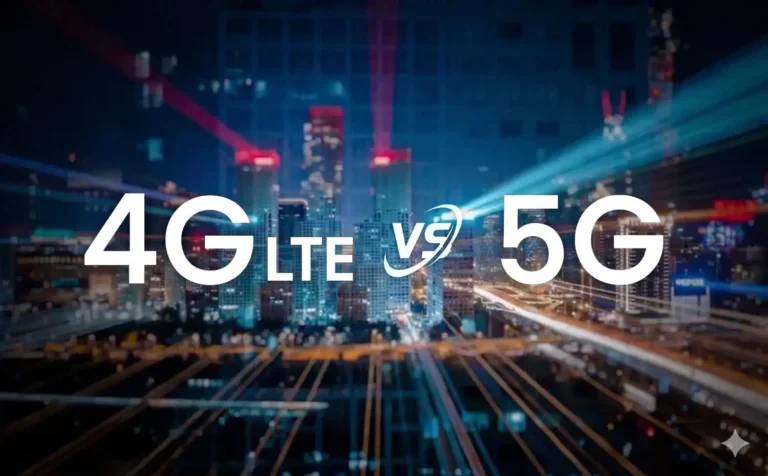
4G LTE vs 5G: What’s the Difference and Which Is Better for You?
Quick Summary
4G LTE offers wide coverage, a stable connection, and works well in most areas.
5G provides faster speeds, lower latency, and better performance in supported regions.
Network choice depends on location, device compatibility, and daily internet usage needs.
LTE remains reliable, while 5G is better for high-speed modern applications.
Sidra Jefferi
19Minutes to read
Table of Contents
Mobile internet is part of daily life now. People use it for shopping, videos, calls, and browsing. The topic of 5G vs 4G LTE comes up often because both are widely used today. Even now, 4G LTE still runs most mobile connections, while 5G is slowly expanding in many areas.
The difference between 4G and 5G is not always easy to notice at first. It shows up in how quickly pages load and how smoothly videos play. In some places, 5G is much faster, but in other areas, 4G LTE works just fine. Comparing LTE vs 5G usually depends on location and daily use. Let’s discuss both and determine which is better.
Check Ubifi Internet Availability in Your Area
Enter your zip code below to explore our plans and pricing.
4G LTE vs 5G — At a Glance
Let’s compare 4G LTE vs 5G head-to-head to see which one delivers where it really matters.
Feature
4G LTE
5G
Max Speed
100-300 Mbps (typical peak)
1-10 Gbps (lab conditions)
Real-World Speed
20-100 Mbps (most locations)
50-500 Mbps (urban areas)
Latency
30-50 ms (noticeable lag)
1-10 ms (near instant)
Coverage
Nationwide (reliable)
Spotty (city centers only)
Best For
Social media, music streaming
Gaming/VR, 4K streaming
Battery Drain
More efficient
Higher (15-20% more)
Device Support
Works on most devices
Almost all new devices
Network Congestion
Slows in busy areas
Handles crowds better
Indoor Coverage
Strong (better penetration)
Weak (struggles through walls)
What is 4G LTE?
4G LTE (Long-Term Evolution) is the mobile network most people still use every day. It made it possible to stream HD videos, make video calls, and browse the internet smoothly on smartphones.
The term 4G means fourth-generation mobile technology. LTE is the standard that helps deliver faster, more stable internet than older networks. Even though 5G is newer, 4G LTE is still widely used because it works in most places, including cities, suburbs, and rural areas.
4G LTE works by sending data between your phone and nearby cell towers using radio signals. When a website is opened or a video starts playing, the phone connects to the nearest tower. That tower sends and receives data through a high-speed internet network and delivers it back to the device almost instantly.
LTE networks use different frequency bands, usually between 600 MHz and 2600 MHz, depending on the carrier and location. Lower bands help signals travel farther and perform better indoors, while higher bands can support higher speeds in busy areas. This is one reason 4G LTE still works well in many rural and suburban areas.
Benefits of 4G LTE Network
4G LTE remains a popular choice because it offers dependable internet for daily use.
Reliable Speeds: Handles streaming, video calls, browsing, and social media without major issues.
Wide Coverage: Works in most cities, towns, highways, and many rural areas.
Supports Most Devices: Compatible with almost all smartphones, tablets, and hotspots.
Better Battery Life: Uses less battery on many devices compared to 5G.
Affordable Plans: Usually cost less than many 5G mobile plans.
Stable Connection: Provides more consistent performance in areas with limited 5G coverage.
LTE has been around for years and continues to provide stable, reliable internet to millions of users every day.
What is 5G?
5G is the fifth generation of cellular network technology. It’s the successor to 4G LTE, designed to deliver significantly faster data speeds, near-instant connectivity, and greater network capacity. Unlike previous generations that primarily focused on smartphones, 5G is built to connect everything from smart devices to industrial equipment with ultra-reliable performance.
At its core, 5G represents a fundamental shift in how wireless networks operate, using advanced radio technologies and network architecture to handle our increasingly data-heavy world. It’s not just an incremental improvement but a new platform enabling transformative applications we’re just beginning to explore.
How Does 5G Work?
5G transmits data using much higher frequency bands than 4G LTE, including millimetre wave spectrum. This lets it carry significantly more data at faster speeds. Since these high-frequency signals do not travel as far, 5G networks require more towers placed closer together, especially in busy urban areas. It also uses beamforming technology, which directs the signal straight to your device instead of broadcasting it in all directions.
Types of 5G
5G is not the same everywhere. Different types of 5G use different frequency bands. Some focus on faster speeds, while others focus on better coverage.
Low-Band 5G
Low-band 5G covers large areas and works better indoors. It is commonly used in rural and suburban areas. The speed is slightly better than 4G LTE, but its main benefit is wider, more stable coverage.
Mid-Band 5G
Mid-band 5G offers a balance between speed and coverage. It is faster than low-band 5G and works well in cities and towns. Many users get smoother streaming, faster downloads, and better performance during busy hours with mid-band 5G.
High-Band 5G (mmWave)
High-band 5G, also called mmWave, is the fastest type of 5G. It can deliver very high download speeds and low lag. The signal does not travel far and can be blocked by walls, buildings, and trees. Because of that, it is mostly available in crowded places like stadiums, airports, and downtown areas.
Standalone(SA) and Non-Standalone(NSA) 5G
Some 5G networks still use part of the older 4G LTE system. This is called Non-Standalone 5G or NSA 5G. Standalone 5G or SA 5G runs fully on a 5G network. It can provide faster response times and better overall performance.
Each type of 5G works differently. The speed and coverage people get usually depend on the type of 5G available in their area.
Benefits of a 5G Network
The main advantage of 5G over 4G LTE is faster speed and quicker response time.
Faster Downloads: Downloads large files, apps, and videos much more quickly than 4G LTE.
Lower Latency: Reduces lag during gaming, video calls, and live streaming.
Handles More Devices: Works better in crowded places where many people connect simultaneously.
Smoother Streaming: Supports higher quality video streaming with fewer interruptions.
Better for Smart Devices: Helps smart homes, security devices, and connected gadgets work more smoothly.
Improved Network Performance: Delivers more stable internet in areas with strong 5G coverage.
5G internet is designed for faster and more connected experiences. As coverage improves, more users will notice the difference between 4G LTE and 5G in daily use.
4G LTE vs 5G: Key Differences
Let’s do a detailed comparison of 4G LTE vs 5G internet based on different parameters to see how different they are and which is better.
Download Speed
How fast can you get files, videos, and apps on your device with a good internet speed?
4G LTE Internet: Delivers respectable 10-50 Mbps speeds that handle most daily tasks just fine. You can stream HD video, download apps, and browse smoothly. While not groundbreaking, it’s more than enough for average users.
5G Internet: Blows 4G out of the water with potential speeds up to 10 Gbps (theoretical). In real-world use, expect 50-500 Mbps in good coverage areas. That’s 5-10x faster than typical LTE speeds. Perfect for downloading movies in seconds or large work files on the go.
Verdict: 5G wins for raw speed, but LTE is still adequate for most routine use.
Network Latency
The delay before data transfer begins (crucial for gaming/video calls)
4G LTE Internet: Decent 30-50 ms latency works for casual use, but you’ll notice delays in real-time applications. Video calls may have slight pauses, and hardcore gamers will feel the difference.
5G Internet: Game-changing 1-10 ms latency makes everything feel instantaneous. No more frustrating lag in video calls or competitive gaming. AR/VR apps finally work properly.
Verdict: 5G dominates for real-time applications with improved latency.
Coverage & Reliability
Where and how consistently you get service.
4G LTE Internet: Nearly nationwide coverage that just works. More reliable in buildings, rural areas, and while moving. You’ll rarely search for a signal.
5G Internet: Still spotty outside urban centers. High-band mmWave has limited range (a few blocks), while mid-band offers better coverage. Expect inconsistent speeds as you move around.
Verdict: LTE wins for reliability and availability today.
Battery Impact
How much power does your connection use
4G LTE Internet: Proven power efficiency gives you longer usage between charges. More mature technology means less battery anxiety.
5G Internet: Noticeably drains batteries faster (15-25% more) as devices work harder to maintain a connection, especially in areas with spotty 5G coverage.
Verdict: LTE is gentler on your battery life.
Future-Proofing
How well will your service age?
4G LTE Internet: Will remain viable for years (carriers support until at least 2030), but may miss out on next-gen apps and services.
5G Internet: The clear choice going forward. As networks improve and more 5G-only features emerge, early adopters will benefit most.
Verdict: 5G is the future, but LTE isn’t obsolete yet.
Cost
What you’ll pay for the service
4G LTE Internet: More affordable plans with better value for light-to-moderate users. Often, the smarter choice if you don’t need cutting-edge speeds.
5G Internet: Typically $10-20/month more than comparable LTE plans. Premium pricing doesn’t always match real-world benefits, though.
Verdict: LTE offers better value for many users.
In short, 5G shines with blazing speeds and ultra-low latency, but only where coverage exists. 4G LTE delivers wider, more reliable service at lower costs. Your ideal choice depends on whether you prioritize cutting-edge performance (5G) or dependable nationwide coverage (LTE).
Ready for 5G Speeds in Rural Areas? Check Out Our High-Speed Unlimited Plans.
Honestly, it really depends on your location and what you’re doing.
Speed: 5G wins. It is much faster than 4G LTE in areas with strong coverage. This makes it better for heavy use cases like 4K streaming, cloud gaming, and large file transfers.
Coverage: 4G LTE wins. It reaches suburban and rural areas where 5G infrastructure is still lacking. Consistency and reliability are where 4G LTE still performs well.
Everyday use: 4G LTE is more than enough. Streaming, browsing, video calls, and social media all work smoothly without needing 5G speeds.
Urban users: 5G is the better option. If you live in a major city with solid 5G infrastructure, you will notice the speed difference in daily use.
Rural and suburban users: 4G LTE is the smarter choice. A fast network that doesn’t reach you is no good at all.
Overall verdict: 5G is the future, but 4G LTE is the present for most people outside major cities. Choose based on what is actually available and reliable in your area, not just what sounds faster on paper.
How to Choose Between 4G LTE and 5G Internet?
The choice between 4G LTE and 5G depends on your location, phone type, and how the internet is used. Both work well, but each fits different needs.
Choose 4G LTE Internet If:
Coverage is needed in cities, small towns, or rural areas.
Internet use is mostly browsing, social media, video streaming, and calls.
Longer battery life is important.
The phone does not support 5G.
A lower monthly plan cost is preferred.
Choose 5G Internet If:
Strong 5G coverage is available in the area.
Large files are often downloaded, or high-quality video is streamed.
Online gaming is a regular activity, and low lag is needed.
Smart apps and newer cloud-based tools are used.
A newer device is being used for the long term.
For many users, both 4G LTE and 5G work together on the same phone. The device switches based on signal strength and availability. 5G gives faster speeds where it is strong, while LTE stays more widely available in many regions.
In rural areas, stable coverage matters more than top speed. A steady connection that works every day is often more useful than a faster network that is not always available.
For reliable internet options in rural parts of the U.S., contact us today to get started.
FAQs on 4G LTE vs 5G
Is 5G better than LTE?
Yes, 5G is better than 4G LTE because it delivers much faster speeds and lower latency. 5G can be 10 to 100 times faster and offers response times as low as 1 to 10 milliseconds, compared to 30 to 50 milliseconds on 4G LTE. This makes 5G ideal for streaming, gaming, and real-time apps. However, 4G LTE is still more reliable in many areas, especially in suburban or rural regions, where it often provides more stable connections and better battery efficiency.
How fast is 5G network speed in real life?
In real-world conditions, 5G network speeds usually range from 100 Mbps to 400 Mbps for most users on mid-band networks, which are the most commonly used type. In ideal situations with mmWave 5G, found in busy urban areas and stadiums, speeds can exceed 1,000 Mbps. However, typical 5G performance relies a lot on your location, how many users are sharing the tower, and which frequency band your carrier uses in that area.
Should I put my phone on LTE or 5G?
Choosing between LTE and 5G depends on your location and network reliability. If strong 5G coverage is available, it can offer faster speeds and lower latency. However, if the 5G signal is weak or inconsistent, keeping your phone on LTE may provide a more stable connection for browsing, streaming, and everyday tasks.
Is 4G LTE being phased out?
Yes, 4G LTE will be phased out, but not until 2030 or later. Major carriers plan to keep 4G services running for at least the next decade. Even as 5G grows, 4G will still work. Significant shutdowns in developed countries are expected to happen between 2030 and 2045 to make way for faster networks.
How Do 4G LTE and 5G Compare?
4G LTE provides reliable, wide coverage and decent speeds, usually between 10 and 50 Mbps. This makes it great for everyday tasks like streaming, gaming, and remote work. In contrast, 5G offers much faster speeds, lower latency, and improved performance for data-heavy applications. Still, 5G coverage is growing, which means 4G LTE is often the more dependable option in many rural and remote areas.
Why is my phone on LTE instead of 5G?
Most newer SIM cards (issued after 2018) support 5G, but some older ones might need replacement. The good news is that carriers usually provide free 5G SIM upgrades. However, your phone itself needs 5G hardware, a SIM swap alone won’t enable 5G on an LTE-only device.
Is it worth upgrading from 4G to 5G?
Upgrading from 4G to 5G can be worth it if you live in an area with good 5G coverage and often use high-bandwidth applications like streaming, gaming, or large downloads. However, if your area primarily relies on LTE networks, you may not notice much difference, and a stable 4G LTE connection may still perform well.
Why am I using LTE instead of 5G?
Many phones automatically connect to LTE when a stronger or more stable signal is nearby. Even if your device supports 5G, the network may switch to LTE to maintain a consistent connection. This often happens indoors, in rural areas, or where 5G infrastructure is not fully developed.
What is the difference between 5G and LTE?
5G is the latest generation of cellular technology. It offers much faster speeds, lower latency, and higher network capacity than LTE, the fourth generation (4G) standard. LTE usually provides speeds between 10 and 100 Mbps, while 5G can reach 600 Mbps or more in areas with strong coverage. For everyday users, this means that 5G can handle more devices at the same time. It also responds quicker for real-time activities like video calls and gaming, and it performs better in crowded areas. However, LTE still covers a much wider geographic area, making it a more reliable option in rural and remote locations where 5G infrastructure has not been set up yet.
How do I change my 4G LTE to 5G?
To switch from 4G LTE to 5G, you usually need a 5G-compatible smartphone, a mobile plan that supports 5G, and access to a location with active 5G coverage. In your phone’s network settings, select the preferred network type and enable 5G if it is available through your carrier.
What is the biggest disadvantage of 5G?
One of the main disadvantages of 5G is its limited coverage compared to LTE, especially in rural or remote areas. High-frequency 5G signals do not travel as far and can be blocked by buildings, trees, or terrain. Consequently, users may experience inconsistent performance or frequent switching between 5G and LTE networks.
Sidra Jefferi is the Marketing Director at UbiFi with deep expertise in corporate actions and a strong understanding of both international and domestic markets. She combines her analytical skills and attention to detail with strategic marketing leadership to help expand UbiFi’s mission of delivering reliable internet to rural and underserved communities.
Internet That Moves With You — Plans Begin at $89.99/mo
Stay online from rural areas or anywhere on the road.